
When "Active" Isn't Enough:
The Need for Exercise

“I skipped the gym, but I took a lot of steps at the office.”
“I didn’t need my workout after running around with the kids.”
“Today’s chores counted as my exercise for the day.”
Hitting 10k steps before lunch, commuting by bike, or chasing the kids around the park are great ways to get moving and stay active. The benefits to an active lifestyle are innumerable. From heart health and respiratory function to digestion and mental well-being, it is in everyone’s best interest to embrace habits that keep them moving.
On the other hand, if your goals are long-term health, fitness, and injury prevention, “active” is not enough. The body requires exercise to support that activity.
What is the difference between activity and exercise?
Activity includes the physical demands from daily responsibilities. This involves all of the general movement throughout the day, from the step count to chores, yard work, hobbies, work responsibilities, and even sporting activities.
Exercise is intentional, progressive, and performed in addition to daily activity. Exercise supplements your activity. This is any physical demand that exceeds the usual daily responsibilities.
General daily activity is fantastic for improving heart health and mood, but it fails to achieve the physiological changes that prevent injury, joint stiffness, muscle loss, and recurring injuries. To optimize long-term health and fitness, the body requires a stimulus that exceeds the daily routine.

How the Body Prepares for Activity
The human body is incredibly efficient and adaptable. It doesn’t waste energy and resources maintaining systems that it doesn’t use often.
The body recognizes the routine and adapts to meet the usual demands as efficiently as possible. The system allocates resources to areas that have greater demand. It pulls resources from areas with less demand and stores any excess for later use. To avoid constantly operating at its maximum capacity, the body establishes a reserve or “buffer zone” for minor day-to-day variability in activities.
The buffer zone is a range of additional activity that the body is prepared to manage, above the daily average.
This acts as a safety mechanism to reduce the risk of injury on days that fractionally exceed the average daily demand. This ensures that connective tissues will not break or degrade with minor increases in activity.
These physiological changes are only maintained if the body recognizes a continued demand for them. If the usual routine doesn’t demand strength, power, or endurance, the body won’t maintain them.
Modifying the Activity Buffer
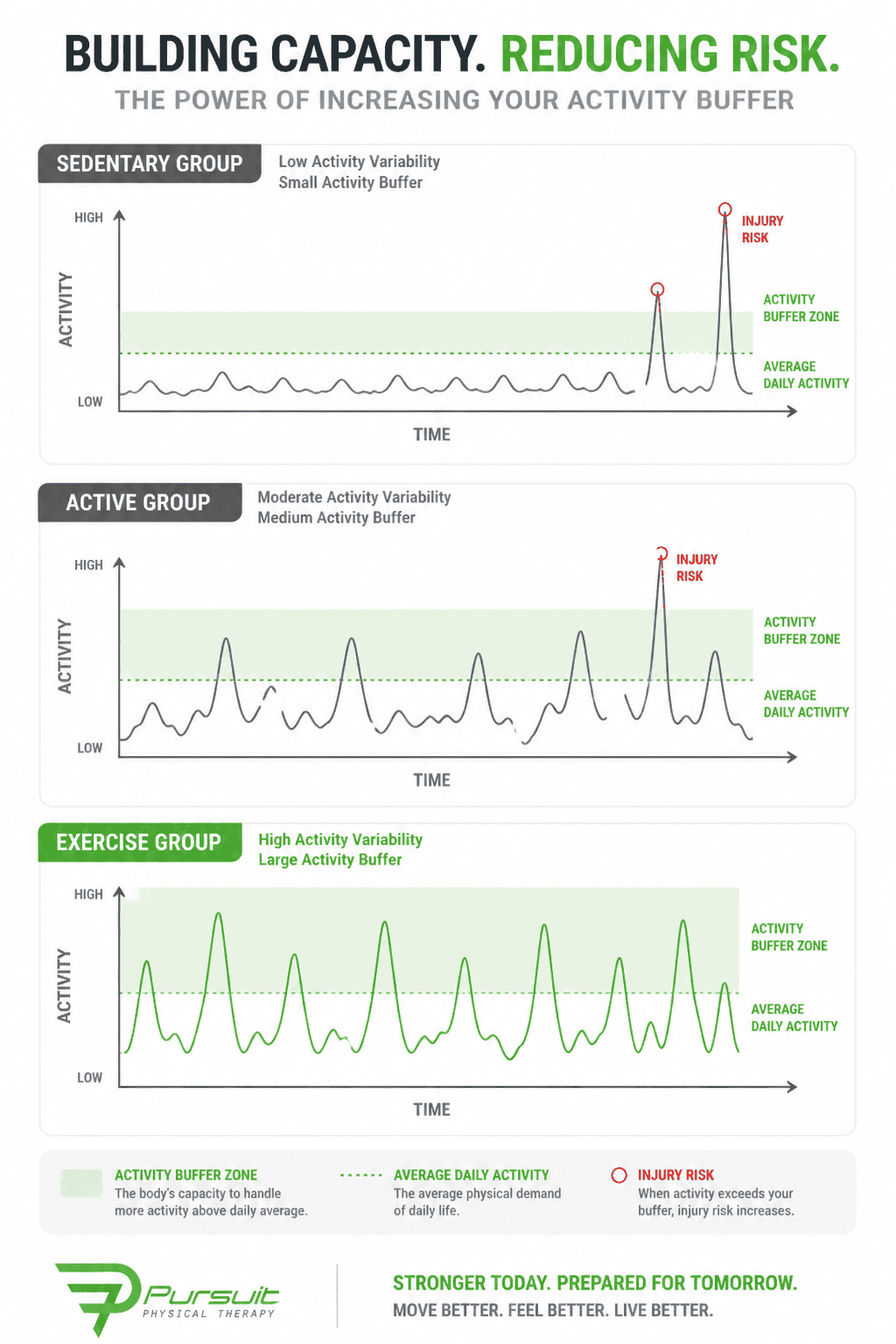
If daily tasks only include walking the dog, light housework, and standing at a desk, it doesn’t need to expend resources to maintain the “expensive” tissues like muscle mass, bone density, and tendon strength. Unfortunately, “trimming the fat” in this scenario means reducing the tissue qualities that maximize fitness and prevent injury. These physical changes result in a smaller activity buffer. Larger spikes in activity that exceed the buffer zone are likely to result in injury or breakdown of the weakened tissue.
The activity buffer zone is not fixed.
Increases in activity help to increase the buffer zone, building fitness and tissue resiliency. As activity increases, the body recognizes the increased demand and shifts resources to build resiliency:
- Greater muscle mass
- Increased bone density
- Increased tendon stiffness
- Improved cardiovascular efficiency
Each of these physiological changes helps to build capacity. These changes result in a larger buffer zone and reduced risk for injury during future spikes in activity.
Why "Active" Isn't Enough
Active people gain all of the general health benefit from staying generally active, but they can miss out on the specific benefits that intentional exercise has to offer. They will typically have a greater activity buffer than sedentary folk, tolerating more physical demands at a lower risk for injury.
The catch is…
The active person has a larger buffer zone, but they also have greater variability in their physical demands. They’re more likely to have a larger spike in activity. If this spike exceeds their buffer zone, it puts them at greater risk for injury.

Building the Buffer
Everyone would benefit from an intentional, structured exercise program. By gradually exceeding their average daily activity, they can safely expand their activity buffer. A thoughtful and individualized exercise program can build their capacity without exceeding the buffer zone and putting themselves at a higher risk for injury. As exercise becomes a regular part of the routine, the body recognizes the increased demand and adapts to prepare for more.
Studies show that performing as little as 1 set of high intensity resistance training per week is sufficient to make improvements in the activity buffer. As long as the exercise program does not exceed the activity buffer zone, further benefits are demonstrated with greater volume or any additional increases in resistance training participation.
Most commonly, I encourage my clients to perform a multi-exercise, multi-set routine 2-3 times per week. These programs are most effective when they are customized to each person’s available time, appropriate workload, and geared toward their specific goals.
Bottom Line
Supplementing an active lifestyle with exercise helps to build capacity and better prepares for more variability and larger spikes in physical demands. Tissues grow stronger. The heart becomes more efficient. The body can tolerate larger spikes in the usual daily activity thanks to a structured exercise program for increasing the activity buffer zone by regularly demanding strength, power, endurance, and tissue resiliency.
An active lifestyle is a great foundation, but it’s not the ceiling.
Activity supports our general health.
Exercise supports our activity.

If you want to reduce pain, avoid injury, and continue doing the things you enjoy long-term, you need more than just movement—you need progressive, intentional training.
If you’re active but still dealing with pain, stiffness, or recurring setbacks, your body may be missing the right stimulus.
Pursuit Physical Therapy specializes in building individualized exercise programs that work within your limits and expand what your body can handle for the long-term.
Get a plan designed specifically for you.
- Discuss your concerns
- Identify your goals
- Learn the steps to develop a customized plan that fits your lifestyle
Staying active is a great start, but if you’re looking to optimize your health and fitness, you’ll need a structured exercise program tailored to your lifestyle. Fill out the form below to get the most out of your fitness routine.

169 W Durham Street
Philadelphia, PA 19119